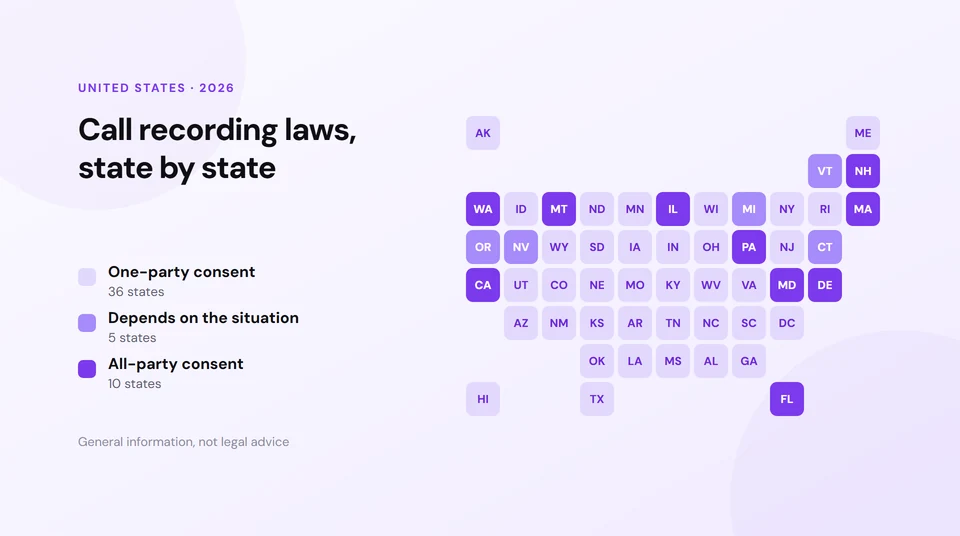
In most of the country you may record a call you are taking part in, without telling anyone. That is the federal rule and the rule in 36 states. Ten states require consent from everyone on the line. Five more sit in between, where the answer turns on whether the conversation happened by phone or in person, or on whether you are facing a criminal charge or a civil claim. And when the two people are in different states, you can end up held to whichever law is stricter.
Say it out loud at the start. “I record my calls so I don't miss any details — that alright?” takes three seconds and satisfies every state at once, because consent given openly is consent under any of these statutes. It is a far cheaper answer than memorising 51 rules, and in practice almost nobody objects.
Epocra records from the moment the call connects, so there is no button to remember and nothing interrupting the conversation. Whether a recording notice plays at the start is an account setting — leave it on and every caller is told automatically, or switch it off where you are entitled to. Every call comes back transcribed, summarised and filed against the contact.
Try Epocra freeSee it in action
See how it works on Epocra
An interactive demo — not a video — of making a call and having it recorded and transcribed. The call ends, and seconds later the recording, transcript and AI summary are waiting — no button pressed, and no announcement mid-call when the notice setting is disabled.
- Recording starts at connect — nothing to interrupt
- Summary and action items after every call
- Filed to the contact, searchable months later
One-party and all-party consent
Every US recording law is a variation on the same question: how many people on the call have to know about it?
One-party consent means one person who is part of the conversation has to agree to the recording — and that person can be you. If you are on the call, you are the consenting party, and you may record without announcing anything. This is the majority position.
All-party consent — often called two-party consent, though it means everyone however many are on the line — requires agreement from each person before you may record. Recording without it is a crime in several of these states and grounds for a civil claim in most of them.
The distinction only matters when the recording is secret. Announce it, and everyone who stays on the call has consented, which is why disclosure is the practical answer almost everywhere.
What federal law says
The federal Wiretap Act, 18 U.S.C. § 2511(2)(d), permits recording where one party to the communication has given consent — unless the recording is made for the purpose of committing a crime or a tort. So federal law is a one-party rule.
What trips people up is assuming that settles it. Federal law is a floor, not a ceiling: states may impose stricter requirements, and a dozen of them do. Being compliant federally tells you very little about whether you are compliant in California.
Call recording laws by state
This is general information, not legal advice, and it is a summary of a complicated area. Statutes get amended, courts reinterpret them, and how a rule applies depends on facts this page cannot know — whether the conversation was private, who was where, and what you intend to do with the recording. Verified August 2026. If a recording matters legally, check the current statute or talk to a lawyer in the relevant state.
| State | Consent required | Notes |
|---|---|---|
| Alabama | One party | |
| Alaska | One party | |
| Arizona | One party | |
| Arkansas | One party | |
| California | All parties | Penal Code § 632 |
| Colorado | One party | |
| Connecticut | It depends | One-party under the criminal statute, all-party for telephone recordings under the civil one |
| Delaware | All parties | 11 Del. C. § 1335 — the statutes conflict; treated as all-party in practice |
| District of Columbia | One party | |
| Florida | All parties | Fla. Stat. § 934.03 |
| Georgia | One party | |
| Hawaii | One party | All-party if the recorder is not part of the conversation and it happens in a private place |
| Idaho | One party | |
| Illinois | All parties | 720 ILCS 5/14-2 — applies to private conversations; rewritten after the 2014 ruling |
| Indiana | One party | |
| Iowa | One party | |
| Kansas | One party | |
| Kentucky | One party | |
| Louisiana | One party | |
| Maine | One party | |
| Maryland | All parties | Cts. & Jud. Proc. § 10-402 |
| Massachusetts | All parties | Gen. Laws ch. 272 § 99 — turns on secrecy rather than consent |
| Michigan | It depends | The statute reads all-party, but courts have held a participant may record |
| Minnesota | One party | |
| Mississippi | One party | |
| Missouri | One party | |
| Montana | All parties | Mont. Code § 45-8-213 — requires notification |
| Nebraska | One party | |
| Nevada | It depends | One-party in person; all-party by telephone under state case law |
| New Hampshire | All parties | N.H. Rev. Stat. § 570-A:2 |
| New Jersey | One party | |
| New Mexico | One party | |
| New York | One party | |
| North Carolina | One party | |
| North Dakota | One party | |
| Ohio | One party | |
| Oklahoma | One party | |
| Oregon | It depends | One-party for telephone calls; all-party for in-person conversations |
| Pennsylvania | All parties | 18 Pa. C.S. § 5703 |
| Rhode Island | One party | |
| South Carolina | One party | |
| South Dakota | One party | |
| Tennessee | One party | |
| Texas | One party | |
| Utah | One party | |
| Vermont | It depends | No wiretapping statute; the state supreme court has limited secret recording in the home |
| Virginia | One party | |
| Washington | All parties | Rev. Code § 9.73.030 |
| West Virginia | One party | |
| Wisconsin | One party | |
| Wyoming | One party |
The five states where the answer is “it depends”
Most summaries force every state into one of two boxes. Five of them genuinely do not fit, and the detail is usually what decides a real case.
Connecticut runs two regimes at once. The criminal eavesdropping statute is one-party, but a separate civil statute makes recording a telephone conversation without everyone's consent grounds for a lawsuit. You can be clear of prosecution and still be sued.
Michigan has a statute that reads like an all-party rule, but Michigan courts have long held that a participant in a conversation is not an eavesdropper, so someone on the call may record it. The safest reading is that it is one-party in practice and all-party on paper.
Nevada splits by medium: in-person conversations are one-party, telephone calls are treated as all-party under state case law. For a call recording page, Nevada is effectively all-party.
Oregon splits the same way but in the opposite direction. Telephone calls are one-party; in-person conversations require you to tell everyone present.
Vermont has no wiretapping statute at all. Instead the state supreme court has held that secretly recording inside someone's home can violate their constitutional privacy rights, which leaves a rule with no clean boundary.
When the call crosses state lines
This is the part that catches out people who checked their own state and stopped there. If you are in Texas, a one-party state, and you call someone in California, an all-party state, which law applies?
There is no single answer. Courts have reached it different ways, and the outcome can depend on where the recording device was, where the harm occurred, and which state's court is hearing the case. California courts in particular have applied California law to calls recorded elsewhere when a Californian was on the line.
The workable approach is to assume the strictest rule that could apply, applies. If either end of the call sits in an all-party state, treat the call as all-party. That is a one-sentence rule you can actually follow, and it happens to be satisfied by the same announcement that solves everything else.
If you record for work
Recording business calls is normal and legal in most of the country, but doing it at volume changes the risk profile: you are not making one judgement call, you are making the same one hundreds of times, and you will not know in advance where every caller is sitting.
Three things make it manageable:
- Disclose by default. Either a spoken line at the start or an automated notice. Consistency matters more than wording — a policy you follow every time is defensible in a way that an occasional habit is not.
- Keep business and personal separate. Recording everything that reaches your personal number sweeps in conversations you had no reason to capture. A dedicated business line records only what is actually business.
- Treat the recordings as records. They are confidential business documents. Store them somewhere access-controlled, and know how long you keep them and who can listen.
None of this is exotic. It is what any company running a call centre has done for decades — the only new thing is that individual professionals now record at the same scale.
What actually works
The reason so many people get this wrong is that consent is treated as a thing you remember to do, call by call, on top of everything else you are doing. Under that model you will forget, and the call you forget on will be the one that mattered.
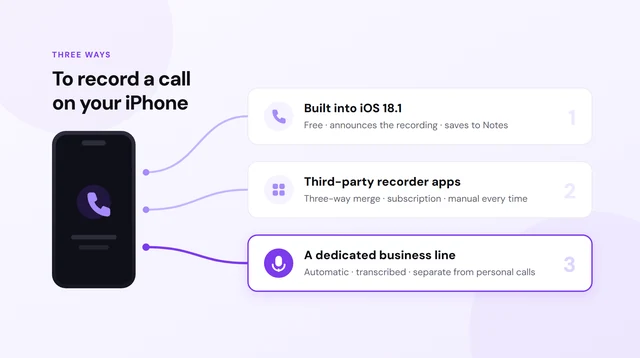
Handle it at the line instead of the moment. Epocra gives you a dedicated business number where recording starts as soon as the call connects — nothing to press, nothing to interrupt the conversation halfway through — and the recording notice is a setting on the account rather than something you have to say out loud each time. Leave the notice on and every caller is told automatically, which keeps you on the right side of the strictest states without thinking about it.
Then the recording turns into something you can use: transcribed with each speaker labelled, summarised in a few lines, follow-ups pulled out as action items, and filed under the contact. Ask a question weeks later — what did we agree on price? — and the answer comes back drawn from the transcripts, citing the call it came from. Searchable across every conversation you ever had.
Frequently asked questions
In most cases yes, if you are on the call. Federal law and 36 states allow a participant to record without telling anyone. Ten states require everyone's consent and five more depend on the circumstances, so where you and the other person are sitting decides the answer.
One-party consent means one person on the call has to agree, and that can be you, so you may record without announcing it. All-party consent means everyone on the line has to agree first. Announcing the recording satisfies both, because anyone who stays on the call has consented.
California, Delaware, Florida, Illinois, Maryland, Massachusetts, Montana, New Hampshire, Pennsylvania and Washington. Connecticut, Michigan, Nevada, Oregon and Vermont sit in between and are worth reading individually rather than filing under either heading.
There is no single rule and courts have decided it different ways. The practical approach is to follow the stricter of the two states' laws — if either end of the call is in an all-party state, treat the whole call as all-party.
Disclosure satisfies the consent requirement in every state, which is why it is the habit worth building. It is not a universal shield — recording made to commit a crime or a tort is unlawful regardless — but for ordinary business calls, announcing it resolves the consent question.
A recording made illegally is generally inadmissible and can expose you to criminal or civil liability of its own, which is the opposite of helpful. If you are recording specifically because you anticipate a dispute, that is the moment to take legal advice rather than rely on a summary like this one.
More in the Help Center: Recording calls and the law.
James Ritter
Founder of Epocra. Fifteen years in payments, now building call intelligence for people who run their business from their phone.
Sources: Reporters Committee for Freedom of the Press — Reporter's Recording Guide · 18 U.S.C. § 2511 (Cornell LII) · Justia — 50-state survey on recording conversations. State positions verified August 2026. This page is general information, not legal advice.
Keep reading