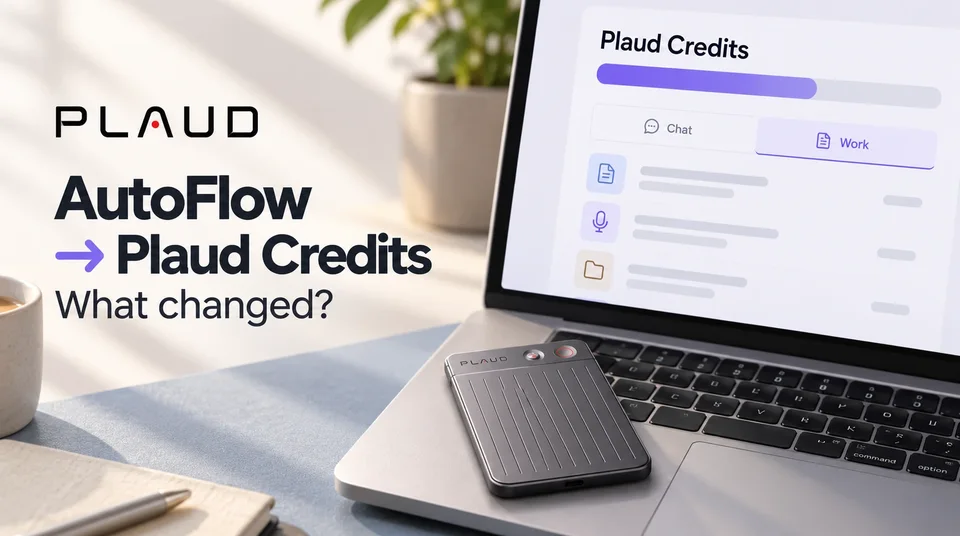
AutoFlow is gone. Plaud replaced it with Routines, and Routines run on Plaud Credits. Your old AutoFlow rules do not carry over, so you rebuild them as Routines. Credits are a new balance, separate from your transcription minutes, spent whenever Plaud’s AI agent does work for you: running a Routine or Skill, making a document, or sending something to Slack or Notion. Transcription and the default AI summary are still free of credits. Existing users got a one-time grant, valid for three months, and Plaud has not published how many credits anything costs.
If what you need automated is your phone calls, Epocra does it with nothing to set up and no credits. It records every call on your normal number, automatically, on any iPhone or Android. After you hang up you get the recording, the transcript, a summary and the follow-ups as tasks, every time, on one subscription.
Disclosure: we make Epocra. Everything said about Plaud comes from Plaud’s own announcements, FAQ and support pages plus launch coverage, checked on 23 October 2026.
See it in action
Every call summarized, automatically
An interactive demo, not a video. Answer a call and see the recording, transcript and follow-ups land in the app once it ends.
- Every call on your number: incoming and outgoing, from the first word
- AirPods, car or speaker: it records the line, not a microphone
- Summary and action items: written for you after every call
What happened to AutoFlow
AutoFlow was Plaud’s set-and-forget automation. When a new recording landed, it could transcribe it, summarize it with the template you chose and email you the result, without you opening the app. On older versions of the app, a preset AutoFlow called “Auto-summarize new recordings” was switched on by default, so many people used AutoFlow without knowing its name.
In October 2026, Plaud rolled out a big update it calls the next generation of Plaud Intelligence. Plaud’s own FAQ puts it plainly: “AutoFlow has evolved into Routines.” Plaud’s AutoFlow help article now only applies to app version 3.30 and earlier; on version 4.0 and later, it points you to Routines instead.
Plaud says existing AutoFlow rules are not transferred automatically. You have to recreate them as Routines. Plaud says that takes a few minutes, but it means writing down what your old rules did before you update.
What does not change: your recordings, and your Summary Templates, which Plaud says “continue to work exactly as they always have.”
What Routines and Skills are
Routines are the new automations. You describe them in plain language in the Plaud Agent tab, and Plaud says they “trigger on conditions, not just schedules”: when a recording finishes, at a time of day, or on a weekly cycle. They can also send results to connected apps, not just email. At launch those are Slack, Notion, Google Calendar, Linear and Zapier.
Skills are saved instructions for a whole task, not just a summary format: the structure, the tone and the kind of output you want. You can use Plaud’s library or describe your own. They sit alongside Summary Templates rather than replacing them.
Both are run by Plaud Agent, the AI assistant at the centre of the update. It can also produce finished documents Plaud calls Artifacts, such as a PDF, a slide deck or a Word file built from your recordings. Before it posts or sends anything to another app, Plaud says the agent asks you to confirm.
What Plaud Credits are
Plaud Credits are a second balance in your account, separate from your transcription minutes. Minutes still pay for turning audio into text. Credits pay for the agent’s work. Plaud’s FAQ is direct about the change that matters for former AutoFlow users: “Running a Skill and Routine involves Plaud Agent taking action on your behalf, hence will consume Plaud Credits.”
So automation that used to come with your plan as AutoFlow now draws on credits each time it runs. How many depends on the task: Plaud says usage “varies depending on the complexity of the task”. You can see your balance and history in the app, on the web dashboard and in account settings.
What is free and what costs credits
| What you do | What it uses |
|---|---|
| Transcription and re-transcription | Transcription minutes |
| The default AI summary | Nothing extra |
| Regenerating a summary or switching template | No credits |
| Asking the agent to rewrite a summary | Credits |
| Running a Routine (the AutoFlow replacement) | Credits |
| Running a Skill | Credits |
| Creating an Artifact (PDF, slides, Word, HTML, Markdown) | Credits |
| Sending work to Slack, Notion, Linear or Zapier | Credits |
The line to watch is the second Routine row: anything you want to happen on its own, the way AutoFlow used to, is a Routine, and every Routine run uses credits.
How many credits you get
- Existing individual users get a one-time grant of credits when they update the app. No code is needed, and the grant is valid for three months.
- Team plans get a one-time gift of credits for every occupied seat. It does not renew monthly.
- Plaud One buyers get $200 in Plaud credits with the $249.99 earbuds.
- Top-up packs are sold in the Plaud app. For Team accounts, Plaud says they stay valid for one year.
Plaud has not published how many credits the grant contains, whether any plan includes a monthly allowance, or what a top-up pack costs. Your plan price itself has not changed: Pro is still $17.99 a month or $99.99 a year, and Unlimited is $29.99 a month or $239.99 a year. On Unlimited, transcription stays unlimited, but credits still apply to the agent.
When you run out
Plaud says you are not charged automatically. Transcription and the standard AI summary keep working. Everything that uses the agent pauses until you top up: Routines stop running, Artifacts cannot be created, and nothing is sent to your connected apps. If you rebuilt your AutoFlow as a Routine, that is the part that quietly stops.
Rebuilding your AutoFlows
- Write your rules down before you update. The update is account-wide and your AutoFlows will not come with you, so note what each one did: which template, which email address, which recordings.
- Let transfers finish. Make sure recordings have finished syncing from your device before updating the app.
- Update the app, then open the Plaud Agent tab. Routines live there.
- Describe each old AutoFlow in plain language as a new Routine, for example “when a recording finishes, summarize it with my meeting template and email it to me.”
- Watch your credit balance for the first week. Plaud has not said what a Routine run costs, so your own usage history is the only way to see how long the grant will last.
What Plaud has not said
- How many credits are in the one-time grant, for individuals or teams.
- What a Routine run, a Skill or a document costs in credits.
- What top-up packs cost, and how long individual top-ups last.
- Whether any plan will include credits every month after the grant runs out.
Plaud says its preview period runs through 31 December. We will update this page when it publishes the numbers.
If you mostly record calls
A lot of people used AutoFlow for one simple job: record a conversation, get the summary without lifting a finger. If those conversations are phone calls, Epocra does that job on its own, with no automation to build and no credits to track.
Epocra records the call itself rather than listening through a device: calls you make in Epocra go out over its own line, and calls to your normal number reach it through one carrier code. So every call is recorded from the first word, in and out, whether you are on speaker, AirPods or in the car. After you hang up, the recording, the transcript, a summary and the follow-ups as tasks arrive on their own, and you can search and ask questions across all your calls. It is one subscription, and nothing pauses when a balance runs out.
Every call summarized, nothing to rebuild
Epocra records every call on your normal number and writes the transcript, summary and follow-ups for you. No routines, no credits.
Start free trialHow Plaud’s own devices handle calls is covered in how Plaud records phone calls and Plaud One vs Epocra.
Sources: Plaud: Introducing Plaud Credits · Plaud: Skills and Routines · Plaud: Artifacts and Connectors · Plaud: Team guide · Plaud Support: AutoFlow · GadgetClarity. Checked 23 October 2026. Plaud is a trademark of its owner.
Frequently asked questions
Plaud’s October 2026 update replaced AutoFlow with Routines, and existing AutoFlow rules do not carry over. If your automatic summaries or emails stopped after updating the app, recreate them as Routines in the Plaud Agent tab. Routines run on Plaud Credits, so they also stop if your credit balance runs out.
In Plaud’s October 2026 update, AutoFlow was replaced by Routines. Plaud’s FAQ says AutoFlow has evolved into Routines, and existing AutoFlow rules do not carry over, so you recreate them in the Plaud Agent tab.
A second balance in your Plaud account, separate from transcription minutes. Credits are spent when Plaud Agent works for you: running a Routine or Skill, creating a document, or sending work to a connected app.
Yes. Plaud’s FAQ says running a Skill or Routine consumes Plaud Credits, so automations that used to be AutoFlows now draw on credits each time they run.
Yes. Transcription uses your minutes, and the default AI summary, regenerating a summary and switching templates do not use credits.
Existing users get a one-time grant, valid for three months, and Team plans get a one-time gift per occupied seat. Plaud has not published the amounts, any monthly allowance, or top-up prices as of 23 October 2026.
You are not charged automatically. Transcription and standard summaries keep working, but Routines, Artifacts and connected-app sends pause until you buy a top-up.
Epocra records every call on your normal number automatically and delivers the recording, transcript, summary and follow-ups after each call, on one subscription with no credits.
James Ritter
Founder of Epocra. Fifteen years in payments, now building call intelligence for people who run their business from their phone.
Keep reading