Plaud now automatically recognizes only your own voice. Its help center, updated on 13 October 2026, says Plaud “does not automatically identify other speakers.” Everyone else in a recording is labelled Speaker 1, Speaker 2 and so on, and any names you add apply to that one recording. The most likely reason is legal risk. Remembering someone’s voice means keeping a voiceprint of them, Illinois law treats that like a fingerprint, and AI note takers that did it are being sued.
A call already knows who is who. Each side of a phone call arrives on its own line, from its own number. Epocra labels the speakers in a call transcript that way, the same way your phone shows who is calling, so it never needs to recognize anyone’s voice to tell them apart.
Disclosure: we make Epocra. Everything said about Plaud comes from its own help center, checked on 13 October 2026. Nothing here is legal advice.
See it in action
Names from the number, not the voice
An interactive demo, not a video. A call ends, and a few minutes later the transcript is waiting with each side labelled by who was on the line.
- Both sides labelled: from the line each voice came in on
- No voice profiles: nobody has to enroll their voice
- Summary and action items: written for you after every call
What changed
Plaud separates the voices in every recording, a process called diarization, and always has. What users valued was the next step. Through the summer, people on the Plaud forums described the app recognizing colleagues it had heard before and putting their names on the transcript without being told. One user wrote in August that Plaud would “successfully recognize and assign other people’s voices to the right names”; another said new recordings were adding speakers automatically.
Plaud’s help articles on speaker labels now say something narrower. Both were updated on 13 October 2026, and both make the same three points:
- Only your voice is recognized. If you record a voice profile of yourself, Plaud labels your speech with your name automatically.
- Everyone else is a number. Other people appear as Speaker 1, Speaker 2 and so on. Plaud does not identify them.
- Names stay in one recording. A name you give Speaker 2 does not carry over to the next recording that person appears in.
The difference is memory. Plaud still tells voices apart inside a recording. What it no longer does, according to its own help center, is remember a voice it heard last week and know who it belongs to.
Why Plaud changed it
Plaud has not given a reason. The most likely one is legal risk, and the timing makes a strong case for it.
To recognize a person in a new recording, software has to keep a profile of how that person sounds. That profile is a voiceprint, and Illinois treats a voiceprint like a fingerprint: a company needs the person’s written consent before it collects one, and can be sued for $1,000 to $5,000 per person when it does not. The colleagues and clients in a Plaud recording never signed anything. Only the Plaud owner did.
Over the past year that exact issue has turned into lawsuits against Plaud’s competitors. Fireflies was sued over its speaker recognition in December 2025. Microsoft was sued over Teams transcription in February 2026. And in August 2026 a federal judge let the voiceprint claims against Otter go forward, finding it plausible that building speaker profiles of meeting participants collects their voiceprints. Two months later, Plaud’s help center says it remembers one voice only: the owner’s, recorded with their agreement.
That is the shape a company chooses when it wants to keep the feature people like (knowing which lines are yours) and drop the part that collects biometric data from people who never agreed to it. Plaud itself has not been sued over this; the cases are below.
How speaker names work in Plaud now
The setup, as Plaud describes it:
- Go to Settings > Preferences > Auto speaker labeling and turn on Label my voice automatically.
- Choose Add your voice profile and speak for at least 30 seconds. You can sync the profile across your devices or delete it later.
- After a recording is transcribed, tap any Speaker label and type a name. You can apply it to that paragraph or to every paragraph from the same speaker.
- If the summary was already written, generate a new one so it uses the names.
Two details catch people out. Re-transcribing a recording resets every name back to Speaker 1, Speaker 2, so name speakers after the final transcription, not before. And a name cannot be cleared back to the default label, only replaced with another name.
For anyone who records the same people every week, this is extra work on every recording. It is also the version of the feature that does not keep a voice profile of anyone who has not agreed to one, and that is the part worth understanding.
What a voiceprint is, and why the law cares
A voiceprint is a mathematical description of how a particular person sounds: the pitch, tone and timbre that make a voice recognizable. Software that can say “this is Dana again” has to compare a new recording against something like that.
Illinois treats a voiceprint the way it treats a fingerprint or a face scan. Its Biometric Information Privacy Act, known as BIPA, says a company that collects one must first tell the person in writing, explain why and for how long it will be kept, get a written release, and publish a policy for deleting it. People can sue over violations themselves, for $1,000 each when a company was negligent and $5,000 when it was reckless or intentional. A 2024 amendment limited that to one recovery per person rather than one per scan, which still adds up quickly across a class of meeting participants.
Texas and Washington have biometric laws that also cover voiceprints, though there only the state attorney general can bring a case. Illinois is where the lawsuits are.
The voiceprint lawsuits against AI note takers
None of these cases involve Plaud. They are the reason voice recognition has become a feature companies think hard about.
| Case | Product | What is alleged, and where it stands |
|---|---|---|
| Cruz v. Fireflies.AI C.D. Illinois, filed December 2025 |
Fireflies meeting assistant | That its speaker recognition creates voice identifiers for meeting participants who never signed up or gave written consent. |
| Basich v. Microsoft W.D. Washington, filed February 2026 |
Microsoft Teams live transcription | That the diarization behind Teams transcripts analyzes each voice’s pitch, tone and timbre, which the plaintiffs say is a voiceprint. Microsoft has asked the court to dismiss, arguing that routine transcription data identifies no one. |
| In re Otter.AI Privacy Litigation N.D. California, filed August 2025 |
Otter meeting assistant | That Otter captures meeting participants’ voiceprints when it builds speaker profiles. In August 2026 the judge let the BIPA voiceprint claims go forward. |
On a phone, swipe the table sideways.
Every one of these is at an early stage. A claim surviving a motion to dismiss means a judge found it plausible enough to continue, not that the company broke the law.
Telling voices apart vs remembering them
Read together, the cases point at one distinction. Splitting a recording into “first voice” and “second voice” is one thing; Microsoft is arguing that it identifies nobody, and that question is still open. Building a profile of a person’s voice and keeping it, so the software can name them the next time, is the part the Otter ruling found plausibly collects a voiceprint.
Plaud’s new design sits on the cautious side of that line. The one voice profile it keeps is yours, which you record on purpose. The people you meet are separated within each recording and then forgotten.
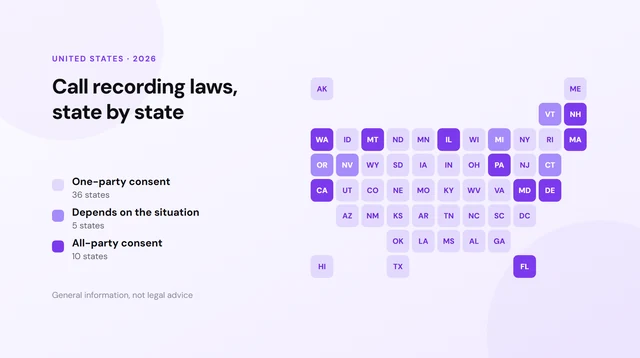
For you as the person pressing record, the practical point is simple. Under BIPA the duties fall on the company collecting the voiceprint, not on you. Recording the conversation in the first place is still governed by the consent rules in your state, which are covered in call recording laws by state.
On phone calls, no voiceprint is needed
A room full of people is a hard problem: every voice arrives through the same microphone, so the only way to know who is speaking is to analyze how they sound. A phone call is different. Each side arrives on its own line, from its own phone number, before anyone says a word.
Epocra uses that. It records a call on the line, with each side kept separate, and labels each speaker by the number they called from, the same way your phone shows you who is calling. A saved contact’s name comes from your contacts, not from their voice. Nobody has to enroll a voice profile, and Epocra does not build one for anyone. After the call you get the transcript, a summary and the follow-ups as tasks.
That only covers calls. If you mostly record in-person meetings, a room recorder like Plaud is built for that job, and how it handles calls is explained in how Plaud records phone calls.
Sources: Plaud: Auto speaker labeling · Plaud: Name speakers · Plaud user forum, August 2026 · Cruz v. Fireflies.AI docket · Basich v. Microsoft docket · In re Otter.AI Privacy Litigation docket · Illinois BIPA (740 ILCS 14). Checked 13 October 2026. This is general information, not legal advice. Plaud, Fireflies, Microsoft Teams and Otter are trademarks of their owners.
Frequently asked questions
Plaud has not given a reason, but the most likely one is legal risk. Recognizing someone by voice means keeping a voiceprint of them, which Illinois law treats like a fingerprint and requires written consent for. Fireflies, Microsoft Teams and Otter have all been sued over voiceprints, and the Otter claims were allowed to proceed in August 2026.
Yes. Plaud still separates the different voices in a recording and labels them Speaker 1, Speaker 2 and so on. If you record your own voice profile, it labels you by name. You can name the others yourself, but the names apply to that recording only.
After transcription, tap a Speaker label, type the name, and choose whether it applies to that paragraph or every paragraph from the same speaker. Regenerate the summary to use the names. Re-transcribing resets all names.
We found no lawsuit against Plaud. The voiceprint cases in the news involve other products, including Fireflies, Microsoft Teams and Otter.
A digital description of how a person sounds, such as pitch, tone and timbre, that lets software recognize the same person again. Illinois law treats it like a fingerprint and requires written consent before a company collects one.
Biometric laws such as Illinois BIPA place their duties on the company that collects the voiceprint. Recording a conversation at all is governed by your state’s consent rules. This is general information, not legal advice.
No. On a call, each side arrives on its own line, so Epocra labels speakers by the phone number they called from, the way your phone shows who is calling. It does not build voice profiles of anyone.
More in the Help Center: What gets recorded.
James Ritter
Founder of Epocra. Fifteen years in payments, now building call intelligence for people who run their business from their phone.
Keep reading