A call notes template is one sheet per phone call — a fixed set of fields for what was decided, what you promised, what they promised, the numbers mentioned and the red flags — so the record of a conversation is captured while it is still verbatim. Free, no email address required.
Prints to one page · the spreadsheet has an example row and 200 formatted rows · Google Sheets: File → Import → Upload
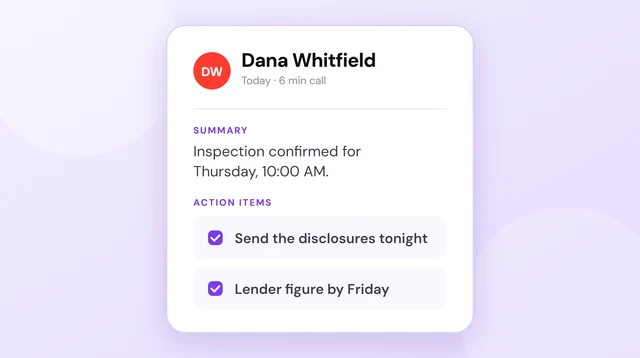
The best call notes are the automatic ones. Epocra records and transcribes every call, then writes the notes for you — the summary, what was decided, and the follow-ups pulled out as tasks — filed under the contact before you have found a pen.
See it in action
The notes that write themselves
An interactive demo — not a video — of a call being recorded and transcribed. The call ends, and seconds later the summary, the decisions and the follow-ups are waiting: every field on the template, filled in automatically.
- You just talk — no juggling a pen and a negotiation
- Summary, decisions and tasks written after every call
- Backed by the transcript when a number is disputed
What call notes are for
Call notes are the record of what happened inside one conversation — not that the call took place (that is the call log’s job) but what it produced: the decision, the price, the promise, the thing they said at minute eleven that changes your week.
The case for a template over a blank page is simple: under pressure, structure beats memory. A blank page invites you to write the wrong things — a transcript-ish scrawl of what was said in order — and to miss the things that matter, because nothing on the page asked for them. A fixed set of fields is a checklist disguised as a form. It asks, every time: what was decided? what did you promise? what number did they say?
The test of good call notes is not how complete they look an hour later. It is whether, three months from now, in a disagreement about money, the sheet answers the question.
The fields that matter
Eleven fields, and each one is on the sheet because its absence has burned someone:
| Field | Why it earns its place |
|---|---|
| Date, time & who | Notes with no date are gossip. Sequence is what makes them evidence. |
| Company / matter | One anchoring detail so the sheet still files itself correctly in November. |
| Why we spoke | One line, like a subject line. Context for everything below it. |
| What they said they need | In their words, not your interpretation. The gap between the two is where deals die. |
| What was decided | The single most valuable line on the sheet. If only one field gets filled, it is this one. |
| What I promised / what they promised | Two fields, split on purpose. Disputes are almost never about what was decided — they are about whose side of the line a commitment sat on. |
| Numbers mentioned | Prices, dates, quantities — verbatim, with units. “About 680” and “$685k” are different facts. |
| Red flags / concerns | The hesitation you heard. It is the first thing you will want before the next call and the first thing memory discards. |
| Next call | Date and purpose — so the follow-up is a plan, not an intention. |
How to take call notes without losing the call
The mechanics matter more than the form. The failure mode of note-taking is trying to write prose while someone is talking — you end up doing both jobs badly. The template is built for a different rhythm:
- Before the call, fill in the top. Who, matter, and why we spoke — thirty seconds that also serve as your prep. If there is a previous sheet for this person, read it; that is the entire point of keeping them.
- During the call, capture only two things: numbers and commitments, verbatim, as fragments. “$685k ceiling — 45 days — disclosures tonight.” Everything else can be reconstructed; a number cannot.
- The two minutes after hang-up are the whole game. Fill in what was decided and both promise fields immediately, while the words are still exact. At two hours they are a paraphrase; tomorrow they are a guess.
- Flag anything that worried you. One line in red flags. You are writing to the version of yourself who prepares for the next call.
- File it and log it. The sheet goes in the client folder; the call gets its one-line row in the call log with a mark that notes exist.
Notes are not the call log
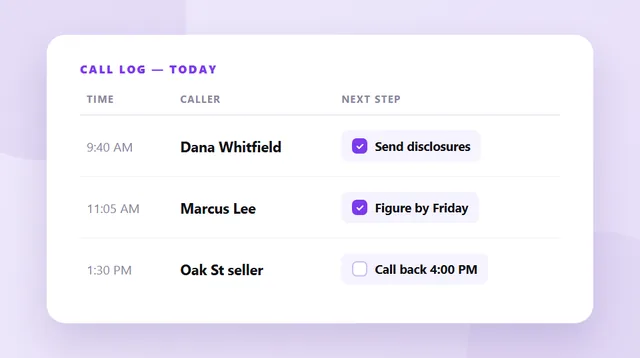
Worth repeating, because the two templates get swapped constantly: the call log is what calls happened — one thin row per call, every call, so the day and the week stay countable. Call notes are what happened inside one call that carried weight. Every call earns a log row; perhaps one in ten earns a notes sheet. Use the log to find the call, the notes to relive it.
Where manual call notes fail
The template above is the best manual version we know how to build. Here is what it still cannot fix, because the problems are structural.
You cannot listen and write at the same time
Note-taking splits attention exactly when the conversation needs all of it. The moments most worth capturing — a negotiation turning, a client getting uncomfortable — are the moments you are least able to stop and write. The best calls produce the worst notes.
The notes say what you heard, not what was said
Every field is filled in by one side of the conversation, after the fact. The $685k on your sheet is the number you heard. When the other side heard $650k, a handwritten sheet is your recollection with a border around it — better than nothing, but it settles nothing.
Paper does not answer questions
A sheet in a folder is retrievable if you remember it exists and know where it is. Ask “when did we first talk about the roof?” and a stack of paper has no answer. Retrieval, not capture, is where manual notes quietly die.
Good call notes require a person to be stenographer, negotiator and archivist at once, live, with no second take. No template fixes that. Taking the person out of the loop does.
What actually works: automatic call notes
Epocra fills in this template automatically. Every call on your Epocra number is recorded from the moment it connects and transcribed with each speaker labelled. Then the notes are written for you: a summary of what the conversation amounted to, the decisions, and the follow-ups pulled out as tasks with owners — filed under the contact, next to every previous call with them.
The difference shows up exactly where manual notes fail. You never split attention, because you are not writing. The record is what was said, not what you heard — and when a number is disputed, the transcript is right there. And the whole archive answers questions in plain English: what did Dana and I agree on price? comes back with the answer and the call it came from.
And you are not stuck with our idea of good notes. The template is editable inside Epocra: keep the default sections — overview, action items, key takeaways, topics — reorder them, or add your own and tell the AI what to capture in plain words. Every call after that comes back summarised in your structure.

Keep the template. Retire the pen.
Epocra records, transcribes and writes the notes for every call automatically — the decisions, the promises and the follow-ups, captured from the audio.
Start free trialFrequently asked questions
A one-page form — printable or spreadsheet — with fixed fields for recording what happened inside a phone call: what was decided, what each side promised, the numbers mentioned, red flags, and when you speak next. The one on this page is free.
Date, time and participants; why you spoke; what they said they need; what was decided; what you promised and what they promised (kept separate); the numbers mentioned, verbatim; any red flags; and the date and purpose of the next call.
Do not try to write prose while listening. Capture only numbers and commitments as fragments during the call, then complete the sheet in the two minutes after hanging up, while the wording is still exact. Fill in the who/why fields before the call as prep.
A call log records that calls happened — one row per call, every call. Call notes record what happened inside one call that mattered. They pair: the log finds the call, the notes carry the detail. There is a free call log template too.
Yes — the PDF on this page prints to one portrait page with ruled space for every field, free with no email required. The spreadsheet version keeps one column per call so a client’s history sits side by side.
Yes. Apps like Epocra record and transcribe the call, then write the notes from the audio — summary, decisions and follow-up tasks — and file them under the contact. The template on this page is the manual version of that record.
More in the Help Center: Call history.
James Ritter
Founder of Epocra. Fifteen years in payments, now building call intelligence for people who run their business from their phone.
Keep reading