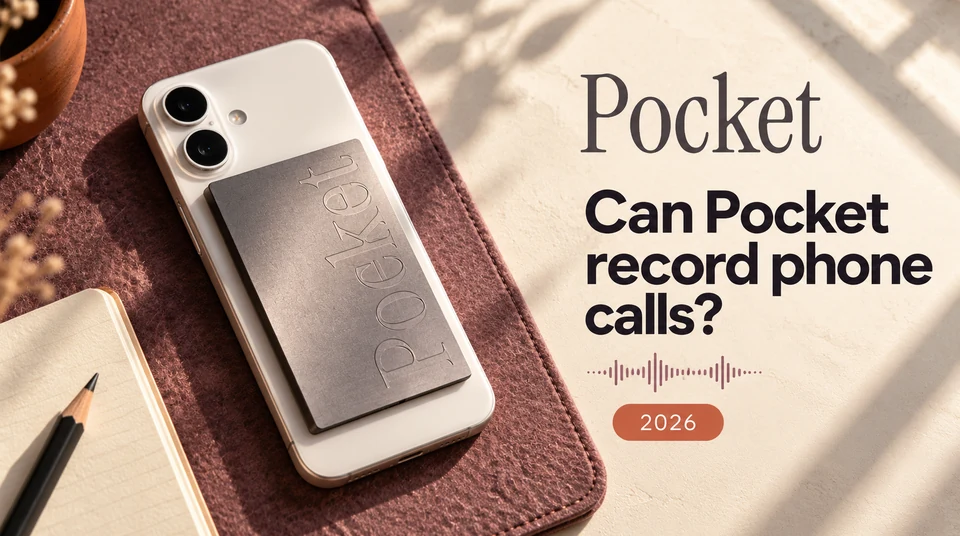
Yes. Pocket can record both sides of a phone call. It does it with a contact microphone that picks up the call through the back of your phone, so it needs no speakerphone and no app permission. You switch it to call mode and press the button on each call you want. It cannot hear the other person if you take the call on Bluetooth earbuds, and Pocket says nothing about telling the other person the call is being recorded.
Record on the line instead. Epocra is a calling app, so both sides of every call are recorded on its own line from the moment the call connects, on any phone, with earbuds or without, and nothing to press. A few minutes later you have the transcript, a summary and the follow-ups as tasks.
Disclosure: we make Epocra. Everything said about Pocket comes from its own website, help guide, community forum and App Store listing, checked on 14 October 2026.
See it in action
Calls recorded on the line
An interactive demo, not a video. No device on the back of the phone: the call is captured on the line and written up when it ends.
- Every call, both sides: recorded from the moment it connects
- Earbuds or not: the line hears both of you either way
- Summary and action items: written for you after every call
How Pocket records a call
Phones do not let apps hear a call, which is why software note takers like Otter cannot record one. Pocket gets around that with hardware. Its spec sheet lists a “contact” microphone that “captures phone calls without speaker”: instead of listening to the air, it picks up the vibrations of the call through the back of the phone.
The device itself is a 52 gram card, about the size of a credit card, with 64GB of storage. It snaps onto the back of an iPhone with MagSafe, and Pocket includes an adhesive mount for phones without it. It has more than 35,000 devices shipped by its own account and a 4.9 rating from 6,700 reviews on the App Store, so it is not a fringe gadget.
Recording a call, step by step
From Pocket’s own guide:
- Attach Pocket to the back of your phone and keep it there for the whole call.
- Move the slider up to call mode. Pocket’s guide says call mode “records phone calls via contact mic; no speaker mode needed.”
- Press the side button once to start. An amber light shows while it records.
- Press again when the call ends, then let the recording sync to the Pocket app.
If you use a case or a mount, Pocket’s troubleshooting guide says to check it is not blocking the microphone ports.
What it misses
- Calls on earbuds. Pocket’s own staff told users that “Bluetooth earbuds are not supported.” With AirPods in, the other person’s voice never reaches the back of the phone, so you get your side only.
- Calls you forget. Recording starts when you press the button. Pocket describes no automatic call detection, so the call that rang while it was in your bag, or that you did not expect to matter, is not recorded.
- Calls when it is not attached. It has to be on the phone, charged, and in call mode, every time.
- Any notice to the other person. Pocket says “phone call transcription requires consent” but nothing plays on the call. Telling people is on you.
Pocket answers “can I record this call?” well. It does not answer “was every call recorded?”, because that depends on you remembering, every time.
How good are the recordings?
Pocket publishes no accuracy figure for phone calls, and we could not find an independent test of its call audio. What is on the record:
- Two accuracy tiers. The free plan gives “standard accuracy” transcription; Pro, at $19.99 a month, gives “highest accuracy”. If transcript quality matters, Pocket’s own pricing points you to Pro.
- Its own testimonials. Pocket’s product page quotes a customer calling it “surprisingly accurate for a phone call.” That is a review Pocket chose to show, not a measurement.
- Contact matters. The microphone hears the call through the back of the phone, so a thick case, a loose mount or the device shifting during the call can all affect what it picks up. Pocket’s guide asks you to keep it attached and make sure nothing blocks it.
The fair summary is that Pocket can record calls well, but there is no published evidence of how well, call to call. If you buy one, make a test call to someone before relying on it for one that matters.
What you get afterwards
Once a recording syncs, the Pocket app gives you a transcript with speaker labels, a summary, action items, mind maps, and “Ask Pocket”, a chat over your recordings. Pocket says its AI is “powered by GPT-5, Claude, and more,” and that data is stored on your device or US servers and is never sold or shared. Pro adds speaker name detection, templates and integrations.
What it costs
The device is a one-time purchase: $129 on Pocket’s sales page (regular price $199, and promotions vary). There is no required subscription. The free plan includes unlimited standard-accuracy transcription with limits on chat and history. Pocket Pro is $19.99 a month, or $199 a year through the App Store, and adds the most accurate transcription, speaker names and unlimited summaries.
The class action against Pocket
On 20 August 2026 a proposed class action was filed against Pocket’s maker, Open Vision Engineering, in federal court in Northern California (Nabiyev v. Open Vision Engineering, Inc.). According to a summary by the law firm Frankfurt Kurnit, it alleges that:
- Pocket is a device designed for eavesdropping under a California law that bans making or selling one, pointing to ads that ask whether using it is “cheating” and promise an “unfair advantage.”
- Its ads leave out that a number of states require everyone on a call to agree to the recording.
- Recordings go to AI providers such as OpenAI, Anthropic and Google, despite the “never sold or shared” promise.
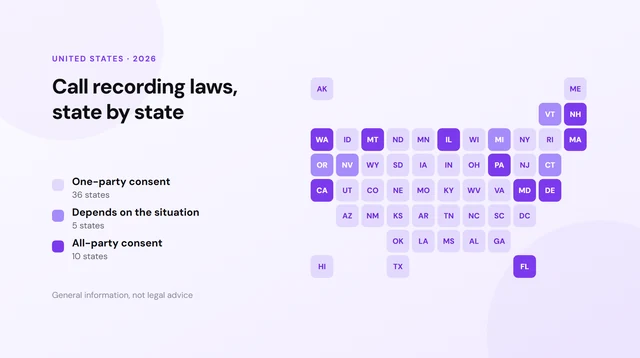
These are allegations at an early stage; nothing has been decided. For you as a user, the practical point is the second one: whatever device or app you use, the consent rules for a call depend on where you and the other person are, and they are listed in call recording laws by state. This is general information, not legal advice.
Recording on the line instead
Pocket and Epocra solve the same problem from opposite ends. Pocket adds a microphone to the phone. Epocra is the phone line: calls you make in the Epocra app go out over its own line, and calls to your normal number reach it through one call-forwarding code from your carrier. The line records both sides from the moment the call connects, each side on its own track straight from the call itself, so there is nothing to attach, charge or switch on, and earbuds make no difference.
A notice plays at the start of each call by default, before anyone speaks, and you can turn it off in Settings where the law allows. After the call you get the transcript with each speaker labelled, a summary, and the follow-ups as tasks. Epocra starts with a free trial, then $24.99 a month. Pocket costs less if you only record some calls; Epocra is for when every call needs to be on the record.
Sources: Pocket product page · Pocket help guide · Pocket community forum · Pocket on the App Store · Frankfurt Kurnit on the class action · Nabiyev v. Open Vision Engineering docket. Checked 14 October 2026. Pocket is a trademark of its owner.
Frequently asked questions
Yes, in call mode. Its contact microphone picks up the call through the back of the phone, so it records both people without speakerphone. It needs to stay attached for the whole call.
No. You switch it to call mode and press the side button to start each recording. Pocket describes no automatic call detection.
Not for the other side of the call. Pocket staff have said Bluetooth earbuds are not supported, because the call audio goes to the earbuds instead of the phone.
Pocket does not say that anything plays on the call. It says phone call transcription requires consent, so telling the other person is up to you.
The device is a one-time $129 on its sales page (regular $199). The free plan includes unlimited standard transcription; Pocket Pro is $19.99 a month.
Yes. A proposed class action filed in August 2026 in Northern California alleges its ads promote recording without disclosing consent laws and that recordings go to AI providers. These are allegations; nothing has been decided.
Epocra records both sides of every call on its own line from the moment it connects, on the number you already have, and writes the transcript, summary and follow-ups.
More in the Help Center: What gets recorded.
James Ritter
Founder of Epocra. Fifteen years in payments, now building call intelligence for people who run their business from their phone.
Keep reading