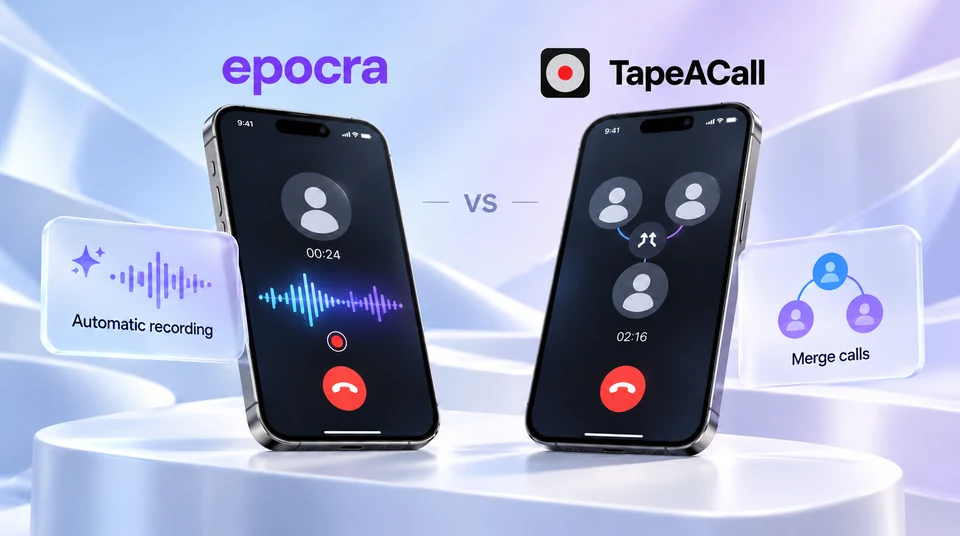
They solve different problems. TapeACall is a merge-call recorder: you keep using the iPhone’s own Phone app, and a recording line is added to the call as a third party. It suits someone who records a call now and then and wants to stay in the native dialler. Outgoing calls can now be recorded automatically; an incoming call still has to be merged by hand, and your carrier has to support three-way calling.
Epocra is a calling app, so the call itself runs through it. Every call you make or take is recorded from the moment it connects, with nothing to press and no three-way calling involved. A few minutes after you hang up you have the transcript, a summary and the follow-ups pulled out as tasks. At $24.99 a month it also costs less than TapeACall’s $7.99 weekly plan, which works out at about $35 a month.
Disclosure: we make Epocra. Everything said about TapeACall below comes from its own App Store listing and website, checked on 13 October 2026.
See it in action
A call that records itself
An interactive demo, not a video. A call ends, and a few minutes later the recording, the transcript and the summary are waiting, with nothing pressed at any point.
- Records from the moment it connects: incoming and outgoing, with no merge step
- Summary and action items: written for you after every call
- Keeps your number: through one call-forwarding code from your carrier
Side by side
The table is the whole comparison in one place. The sections after it explain each row, because most of the differences come from one design decision and make more sense once you have seen it.
| TapeACall | Epocra | |
|---|---|---|
| How it records | Adds a recording line to the call as a three-way call | The call runs through the app’s own line, which records it |
| Outgoing calls | Automatic, according to its listing (“no more call merging”) | Automatic |
| Incoming calls | You start the recording and merge the calls each time | Automatic, once your number is forwarded |
| What your carrier needs | Three-way calling. Its listing names SimpleTalk and H2O Wireless as US carriers that do not offer it | Call forwarding, for incoming calls only |
| Which app you call from | The iPhone’s own Phone app | The Epocra app |
| After the call | The recording, plus a transcript | The recording, a transcript with speaker labels, a summary, and follow-ups as tasks |
| Asking questions about past calls | Not offered | Yes, across your whole call history |
| Recording notice | Not mentioned in its listing | An announcement that is on by default and is your setting to change |
| Where it runs | iPhone and Android | iPhone, Android, desktop, web and desk phones |
| Price | Free to download, then $7.99 a week (about $35 a month) | Free trial, then from $24.99 a month |
| Best for | Recording a call now and then on your normal dialler | Every call recorded and written up, with nothing to remember |
On a phone, swipe the table sideways.
How TapeACall records a call
Apple does not let any app reach the audio of a call made in the Phone app. Every recorder on the App Store has to work around that, and TapeACall’s way round is the oldest one: it turns your call into a conference call and records the conference.
In practice the app dials a recording line, and that line is merged with the person you are talking to, using the three-way calling feature your carrier already provides. The recording line hears both of you, and the file shows up in the app when you hang up. TapeACall has done this since 2013, it has more than 38,000 ratings on the App Store at an average of 4.3, and it is now part of Bending Spoons. It is the app most people mean when they say “a call recorder for iPhone”.
Two consequences follow from the design.
Your carrier has to cooperate. The listing says so directly: TapeACall requires a carrier that supports three-way calling, and it names SimpleTalk and H2O Wireless as US carriers that do not. On the big three networks it works; on a budget plan it is worth checking before you subscribe.
Incoming calls take a few taps. TapeACall’s current listing says outgoing calls can be recorded automatically, with “no more call merging”. An incoming call is different, because the call already exists before the app is involved: you answer, open the app, start the recording line, and merge the two calls. People who record the occasional interview do not mind that. People who want the call that just rang, the one they were not expecting, are the ones who find it gets in the way.
If you have ever missed the first minute of a call because you were adding the recording line, you have met the one thing a merge-call recorder cannot fix.
How Epocra records a call
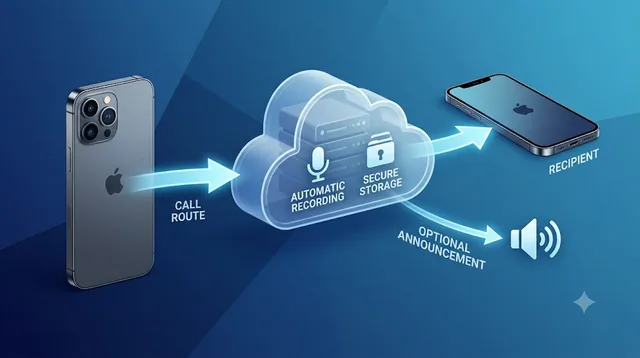
Epocra takes the other route. Instead of adding a recorder to a call that happens somewhere else, it is the phone the call happens on. Calls you make from the Epocra app go out over its own line, and that line records both sides from the moment the call connects. There is no third party to add, so there is nothing to merge and no three-way calling to depend on.
For incoming calls you forward your existing mobile number to the Epocra number you are given. That is one code dialled from your phone, it takes about thirty seconds, and one code turns it off again. From then on, calls to your normal number ring in the Epocra app and are recorded like any other. The people you call still see your own number, so nothing changes from their side.
The trade is real and worth stating plainly: you make and take calls in a different app. If you want to keep using the green Phone icon for everything, Epocra is not that. If you are happy to move your calling into one app in return for never thinking about recording again, that is exactly what it is for. It also means the same account works on a computer and on a desk phone, which a handset-only recorder cannot do.
What you get afterwards
This is where the two products stop being comparable and start being different things.
TapeACall gives you the recording. You can play it, label it, share it by email or text, and send it to Dropbox, Evernote or Google Drive. Storage is unlimited. A transcript is available as well; TapeACall describes its transcription as 99% accurate and says it is powered by AWS. That is a complete answer to “I need a copy of this call”.
Epocra gives you the write-up. The recording and the transcript are there too, with each speaker labelled. What arrives first, a few minutes after you hang up, is a summary of what was discussed and a list of the follow-ups, including the things the other person said they would do. Those follow-ups become tasks. Later you can ask a question in plain language, such as what a client said about their budget last month, and get the answer from across all your calls instead of replaying them.
If the recording is the thing you need, both will give it to you. If what you actually want is not to take notes, and not to forget what you promised, the recording alone does not get you there. Somebody still has to listen to it.
What each one costs
TapeACall is free to download, and the recording features sit behind a subscription bought inside the app. The subscription is $7.99 a week. Billed every week, that comes to about $35 a month, or roughly $415 a year. The App Store listing also shows other purchases from $8.99 up to $89.99 without saying what each one covers, so check the plan length on the screen the app shows you before you confirm.
Epocra starts with a free trial. After that, plans start at $24.99 a month, which covers ten hours of recorded calls a month, plus the transcripts, summaries, tasks and AI questions that come with every plan.
So the usual assumption, that the simple recorder must be the cheap option, does not hold here. At TapeACall’s weekly price, Epocra costs less each month and includes the transcript, the summary and the follow-ups on top of the recording. What TapeACall offers in return is staying in the iPhone’s own Phone app.
Where TapeACall is the better pick
- You record a call now and then. A few interviews a month does not justify moving your calling into another app.
- You want to keep the native Phone app. TapeACall leaves your dialler, your recents and your voicemail exactly where they are.
- You only need the file. If the recording is going straight into Dropbox or to a transcriptionist, the extra layers are wasted on you.
- You want a long track record. More than a decade on the App Store and tens of thousands of ratings count for something.
Where Epocra is the better pick
- Every call should be recorded. Nothing to start, nothing to merge, and nothing to remember when the phone rings unexpectedly.
- Incoming calls matter as much as outgoing ones. A client calling you back is recorded the same way as a call you placed.
- Your carrier does not support three-way calling, or it does and the merge is unreliable on your plan.
- You want notes, not audio. The summary and the follow-ups are the product; the recording is the evidence behind them.
- You work across devices. The same calls and history on your phone, your computer and a desk phone.
If neither description sounds like you, there are other ways to record a call on an iPhone, including the recorder Apple built into iOS. They are compared in the full roundup of iPhone call recording apps.
A word on consent
Neither app changes what the law asks of you. A merge line and a recording line are treated the same way: in most US states it is enough that you, as a participant, agree to the recording, while ten states expect every person on the call to say yes and a few more depend on the circumstances. The location of each caller is what counts. Every state is covered in our state-by-state guide to recording laws. This is general information and not legal advice.
Sources: TapeACall on the App Store · TapeACall features · TapeACall on Google Play · Epocra pricing · Epocra: what gets recorded. Prices and features checked 13 October 2026. TapeACall is a trademark of its owner and is named here for comparison only.
Frequently asked questions
It depends on how you call. TapeACall keeps you in the iPhone Phone app, which suits recording a call now and then. Epocra records every incoming and outgoing call automatically and writes a summary with action items, which suits people who want all their calls on the record.
Yes. Its App Store listing was last updated in April 2026. It records by adding a recording line to the call as a three-way call, so your carrier has to support three-way calling.
According to its App Store listing, outgoing calls can be recorded automatically without merging. For an incoming call you start the recording and merge the calls yourself each time.
No. Epocra is a calling app, so calls run through its own line and are recorded there. The only carrier feature it uses is call forwarding, and only so that calls to your existing number reach the app.
Epocra. TapeACall costs $7.99 a week, which is about $35 a month. Epocra starts with a free trial and then costs from $24.99 a month, including transcripts, summaries and tasks.
Yes. TapeACall works alongside your normal line. With Epocra you forward your existing number using one carrier code, and the people you call still see your own number.
TapeACall provides the recording and a transcript. Epocra provides both of those plus a written summary and the follow-ups as tasks, and lets you ask questions across your past calls.
More in the Help Center: What gets recorded.
James Ritter
Founder of Epocra. Fifteen years in payments, now building call intelligence for people who run their business from their phone.
Keep reading