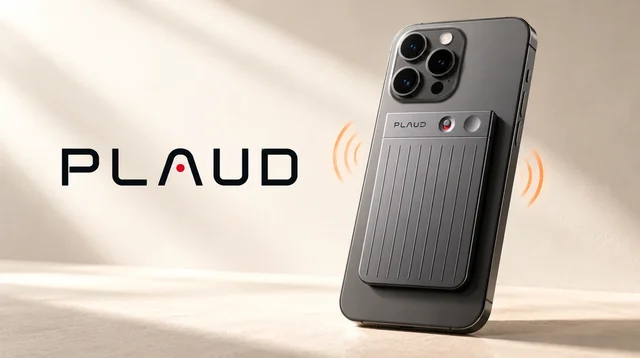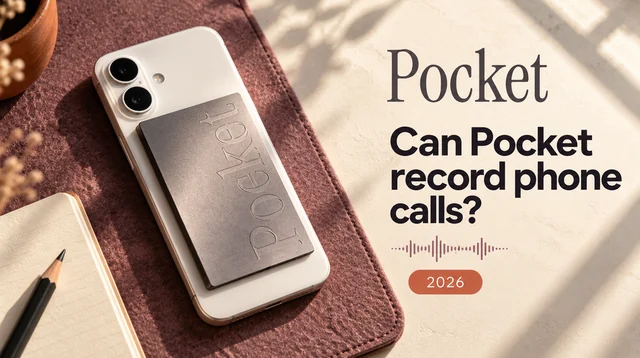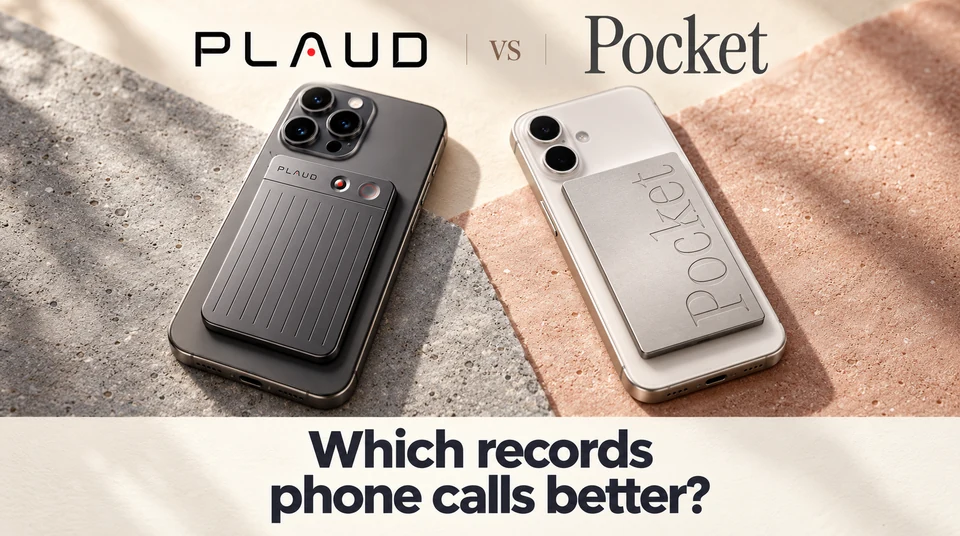
For phone calls they are closer than the marketing suggests. Both clip to the back of your phone and pick up the call through vibration, both need you to start each recording, and neither can hear the other person when you take the call on earbuds or a headset. Plaud’s answer is its own earbuds, Plaud One, announced for later this year; Pocket has no equivalent. Pocket is the cheaper device and its free plan has unlimited standard transcription. Plaud has the more mature lineup, and the Note Pro switches into call mode by itself. Neither publishes how accurate its call transcripts are, so for call quality there is no proven winner.
Record on the line instead. Epocra is a calling app, so both sides of every call are recorded on its own line from the moment the call connects, earbuds or not, with no device to attach or start.
Disclosure: we make Epocra. Everything said about Plaud and Pocket comes from their own help centers, product pages and pricing, checked in October 2026.
See it in action
No device, every call
An interactive demo, not a video. Nothing on the back of the phone: the call is recorded on the line and written up when it ends.
- Starts by itself: every call from the moment it connects
- Earbuds welcome: the line hears both sides either way
- Summary and action items: written for you after every call
Plaud vs Pocket side by side
The comparison below is about phone calls only. Both companies also sell these devices for meetings and in-person notes, which is a different test.
| Plaud (Note, Note Pro) | ||
|---|---|---|
| How it hears a call | A “vibration conduction sensor” feels the vibration of the phone’s speaker through the back of the phone | A “contact microphone” feels the same vibration through the back of the phone |
| Which models | Note and Note Pro. NotePin and NotePin S cannot record calls | One device, with a call mode switch |
| Starting a recording | Press Record on every call. Note Pro picks call mode itself | Set call mode, then press the button on every call |
| Earbuds and headsets | Not supported with the Note or Note Pro. Plaud’s own Plaud One earbuds, announced for late 2026, are meant to fix this; other earbuds will not | Not supported for calls |
| Device price | Note $159, Note Pro $189 | $129 (regular $199) |
| Free transcription | 300 minutes a month | Unlimited, at standard accuracy |
| Paid plan | Pro $17.99 a month or $99.99 a year (1,200 minutes); Unlimited $29.99 a month or $239.99 a year | Pro $19.99 a month, or $199 a year in the App Store |
| Naming speakers | Recognizes only your own voice; you name others per recording | Pro adds automatic speaker name detection |
On a phone, swipe the table sideways.
How each one hears a call
Phones do not let apps listen to calls, which is why software note takers cannot record them. Plaud and Pocket both get around that the same way: with hardware pressed against the back of the phone.
Plaud uses what it calls a vibration conduction sensor. Its help center says the device has to sit on the back of the phone because the sensor “needs to pick up sound directly from the phone’s speaker.” Only two Plaud devices have it: the Note and the Note Pro. The smaller NotePin and NotePin S record in-person conversations only. How it works in more detail is in how Plaud records phone calls.
Pocket lists a “contact” microphone that captures calls without speakerphone. A contact microphone hears through whatever it touches rather than through the air, so it is also picking up vibration; the two companies simply use different names for the same idea. It is one card-sized device that snaps on with MagSafe, with an adhesive mount for other phones, and a switch that moves it between call mode and conversation mode.
In practice the two approaches are the same idea, and they share the same weak point: the device only hears what reaches the back of the phone.
Recording a call with each
- Plaud Note: attach it, switch to call recording, press Record. Plaud says plainly that it does not support automatic call recording, because phones stop apps from watching for calls all day.
- Plaud Note Pro: the same, except it chooses between call mode and in-person mode on its own using its sensors. You still start the recording.
- Pocket: attach it, slide the switch up to call mode, press the side button. An amber light shows while it records.
Afterwards both sync to their app and give you a transcript, a summary and action items, with a chat over your recordings. Plaud recognizes only your own voice and leaves everyone else as Speaker 1 and Speaker 2 (the reason is covered here); Pocket’s Pro plan offers automatic speaker names.
What each one costs
On the device, Pocket is cheaper: $129 on its sales page against $159 for the Plaud Note and $189 for the Note Pro. On the free plan, Pocket is more generous too, with unlimited standard-accuracy transcription against Plaud’s 300 minutes a month.
Paid plans are close. Plaud Pro is $17.99 a month or $99.99 a year for 1,200 minutes a month, and Plaud Unlimited is $29.99 a month or $239.99 a year. Pocket Pro is $19.99 a month, or $199 a year through the App Store. If you record a lot of long calls, Plaud Pro’s yearly price is the cheapest way to get paid-tier transcription; if you mostly want the device and free transcription, Pocket costs less.
How the recordings sound
Listening back is where the vibration approach shows its limits. Plaud is unusually open about it: its help center has a page called “Low volume or poor sound quality on Plaud Note Pro” that lists the complaints in its own words, including that phone-call recordings “are hard to hear,” that “you can only hear your own voice and not the other party,” and that they “sound too loud and distorted.” Its fixes say a lot about how the sensor works: turn the call volume up to at least 80 percent, take a thick case off, and press the device firmly against the phone.
Independent testing found the same thing. In its Plaud Note review, Tom’s Guide found the default sensitivity “not strong enough” for a quiet caller: the voice was in the recording but not loud enough for the AI to transcribe it.
Pocket has no equivalent help page, and we found no independent test of its call audio. It hears calls the same way, through the back of the phone, and its own guide warns that a case or mount blocking the microphone affects the result, so the same weak spots are likely. Neither company publishes how accurate its call transcripts are. With either one, expect your own voice to come through clearly and the other person to depend on your call volume, your case and how well the device is seated, and make a test call before relying on it.
What both of them miss
- Calls on earbuds and headsets. Both companies say earbuds, AirPods and headphones are not supported for calls. The other person’s voice goes into your ears, so neither device can hear it in any mode. Plaud’s fix is its own Plaud One earbuds, and only that pair.
- Calls through the car. Call mode stops working once the call moves to the car’s Bluetooth, because the sound no longer reaches the back of the phone. But the call does play out loud, so switching to in-person mode lets either device pick it up the way it picks up a meeting, road noise included. You get the call, at the quality of a voice memo rather than a call recording.
- Calls you did not start. Neither starts recording on its own when a call comes in. If you forget to press the button, or a quick call turns into an important one, it is not recorded.
- Calls when the device is elsewhere. It has to be on the phone, charged, and in the right mode, every time.
- Telling the other person. Neither documents a notice that plays on the call, so consent is up to you. The rules by state are in call recording laws by state.
One difference worth knowing: Pocket’s maker is facing a proposed class action filed in August 2026 over how it advertised recording, covered in can Pocket record phone calls. These are allegations, and nothing has been decided. We found no comparable case against Plaud.
Which one to pick
- Pick Pocket if price matters most and you want plenty of free transcription. It is the cheaper device with the more generous free plan.
- Pick the Plaud Note Pro if you switch between meetings and calls all day and want the device to choose the mode for you.
- Pick the Plaud Note if you want Plaud’s app and plans at the lower Plaud price.
- Wait for Plaud One if earbuds are the problem. Plaud announced its own recording earbuds in August 2026 for about $249, shipping in the fourth quarter. They record calls through the earbuds themselves, so you would need to take your calls on Plaud One rather than your usual pair. We have not tested them.
Recording on the line instead
Every gap above comes from the same place: the recorder sits outside the call and has to be there, switched on, every time. Epocra takes the other route. It is a calling app, so calls you make go out over its own line, and calls to your normal number reach it through one carrier code. Both sides are recorded straight from the call, each on its own track, from the moment it connects. Earbuds, the car, cases and forgotten buttons make no difference.
After each call you get the recording, the transcript, a summary and the follow-ups as tasks. Epocra starts with a free trial, then $24.99 a month, so both devices cost less if you only record now and then. Epocra is for when every call needs to be on the record without anyone having to remember.
Sources: Plaud: phone call recording · Plaud: automatic call recording · Plaud: low volume or poor sound quality · Tom’s Guide: Plaud Note review · Plaud Note Pro · Plaud plans · Pocket product page · Pocket help guide · Pocket on the App Store. Checked October 2026. Plaud and Pocket are trademarks of their owners.
Frequently asked questions
They work the same way and share the same limits, so neither is clearly better at calls. Pocket is cheaper with unlimited free transcription; Plaud’s Note Pro picks call mode by itself. Neither publishes call transcript accuracy.
Your side usually does; the other person depends on call volume, your case and how well the device sits on the phone. Plaud’s own help center lists hard-to-hear, one-sided and distorted call recordings as known problems. Pocket publishes nothing on call audio.
No. With both you start each recording yourself. Plaud says automatic call recording is not supported; the Note Pro only switches modes automatically.
Not for phone calls. Both say earbuds, AirPods and headphones are not supported, because the other person’s voice goes into your ears where neither device can hear it. Plaud’s own Plaud One earbuds, announced for late 2026, are designed to record calls, but only that pair.
Not in call mode once the call is on the car’s Bluetooth. Switch to in-person mode and either device can pick up the call from the car’s speakers, like a meeting, with road noise and at lower quality than a call recording.
The Plaud Note and Note Pro. The NotePin and NotePin S record in-person conversations only.
Plaud Note is $159 and Note Pro $189, with 300 free minutes a month; Pro is $99.99 a year. Pocket is $129 with unlimited standard transcription free; Pro is $19.99 a month.
Neither documents a notice that plays on the call, so getting consent is up to you.
A calling app that records on the line, such as Epocra. Every call to or from your normal number is captured as it connects, with no hardware, and written up afterwards.
More in the Help Center: What gets recorded.
James Ritter
Founder of Epocra. Fifteen years in payments, now building call intelligence for people who run their business from their phone.
Keep reading