An AI call summary is a structured recap of a phone call, written by AI seconds after you hang up — typically an overview of why the call happened, the action items with owners, the key takeaways, and the topics discussed. Done right, it replaces note-taking entirely. The catch: most tools that advertise it only work on video meetings, not on actual phone calls.
Get summaries on the calls that actually run your business. Epocra carries the call on your own business number, records it from the moment it connects, and writes the summary automatically — every call, both directions, no bot joining anything.
See it in action
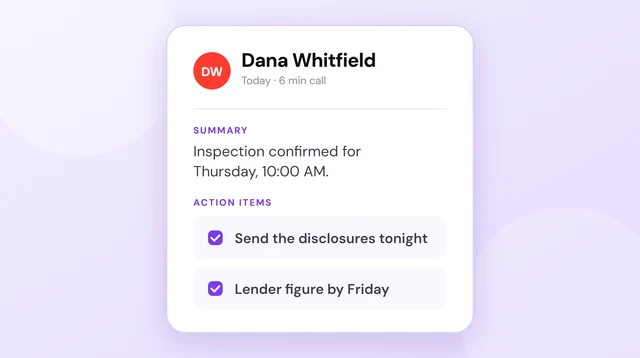
A real summary, seconds after the call
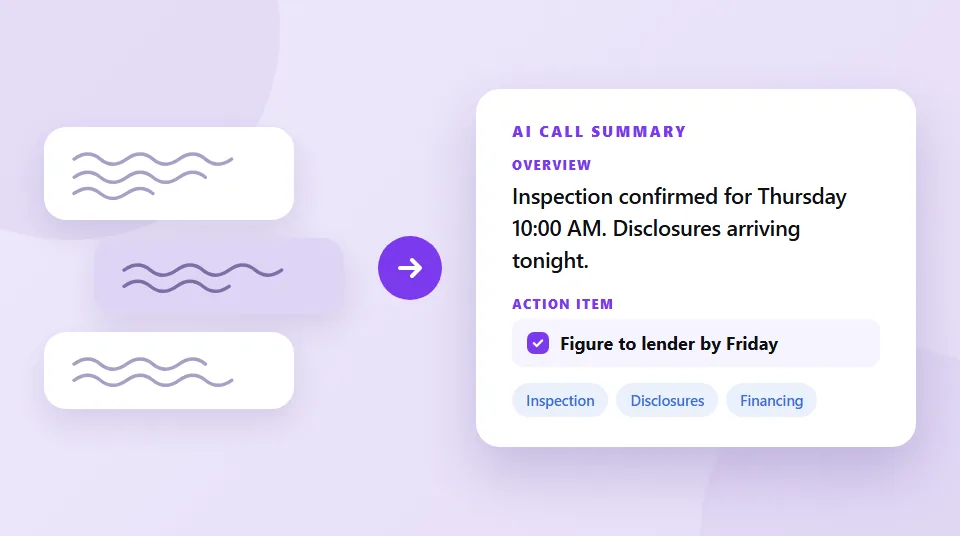
An interactive demo — not a video — of a call being recorded and transcribed. The call ends, and the overview, action items, takeaways and topics are waiting before you’ve put the phone down.
- Automatic on every call — nothing to press, no bot to invite
- Action items become tasks with owners and dates
- Backed by the transcript when a number is disputed
Every section in the summary is yours to shape — keep them, reorder them, or write your own in plain words:

What an AI call summary actually is
A transcript is everything that was said. A summary is what it amounted to — and that distinction is the whole product. Nobody rereads a 1,400-word transcript of a six-minute call; everybody reads the four lines that say the inspection is Thursday, the disclosures arrive tonight, and you owe the lender a number by Friday.
So an AI call summary is a small, structured document generated from the call audio the moment you hang up. Not bullet-pointed shorthand you typed while half-listening — a recap written from what was actually said, in a consistent shape you can scan in ten seconds, filed where the call lives.
One boundary worth drawing before going further: a summary describes one call. What a hundred summaries tell you about a client, a deal, or your own follow-up habits is a different job — AI call analysis — and it has its own guide. A summary is the note from one call; analysis is what all your calls say together.
The four sections that matter
Almost every good summary converges on the same anatomy, because it mirrors what you would have written down yourself on your best day:
| Section | What it answers |
|---|---|
| Overview | Why did this call happen and how did it end? Two or three sentences — the part you’d tell a colleague in the hallway. |
| Action items | Who owes what, by when — split by side, because disputes are always about whose list a commitment was on. The best tools turn these into actual tasks, not just text. |
| Key takeaways | The facts that outlive the call: the number they mentioned, the constraint, the date. What you’ll need in three weeks. |
| Topics | What was discussed, grouped by theme — so a long call is navigable and a client’s recurring themes become visible over time. |
If a tool’s output is a single paragraph of prose, it’s a book report, not a call summary. The structure is what makes it usable at speed.
How it works — and what quality depends on
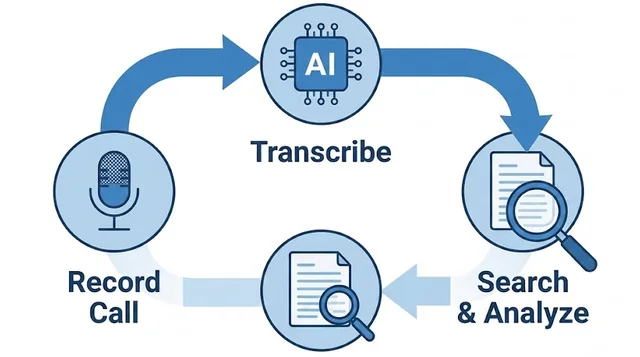
The pipeline is simple to describe: the call is recorded, the recording is transcribed with each speaker labelled, and a language model fills the summary’s sections from the transcript. Every step gates the next, which is why the differences between tools show up where you least expect them.
The recording is everything. A model summarizing a clean, two-channel recording knows who said what and rarely misattributes a commitment. One working from a muffled speakerphone capture guesses — and a summary that confidently attributes your client’s concession to you is worse than no summary at all. This is why summaries built into the calling line itself beat anything bolted on after the fact: the audio is captured at the source, both sides clean.
The template decides usefulness. The model writes whatever sections it’s asked to write. Generic tools ask generic questions; the good ones let you tell the AI what to capture in your own words — which matters enormously by profession. A realtor wants price ceilings and timelines pulled out every time; a contractor wants scope changes; a recruiter wants salary expectations. Same pipeline, very different notes.
The part nobody says out loud: most tools can't touch a phone call
Search for AI summary tools and you’ll find a crowd of excellent products — built for meetings. They work by joining a Zoom or Teams call as a participant, or capturing your computer’s audio. A phone call has no meeting link to join and never touches your laptop, so for the calls that actually run a small business — the client ringing your cell — they simply have nothing to summarize.
The built-in options don’t rescue this. Google ships real call summaries, but only on a Pixel 9 or later, in five countries, announced to everyone on the line. iPhone’s recorder produces a transcript on newer hardware, not a structured summary — and recording on iPhone comes with its own announcement. Android outside Pixel has less than that.
Which leaves one architecture that actually works for phone calls: a service that carries the call — a business number where recording, transcription and the summary happen on the line itself, working identically on any handset because the phone is just the microphone.
What to look for in an AI call summary tool
- Automatic, not a button. The call that matters is the one you didn’t expect. If summarizing requires remembering to start something, the important calls won’t have summaries.
- Speaker labels. “$685k was mentioned” is trivia. “Dana set a $685k ceiling” is a note. No labels, no accountability.
- Action items that become tasks — with owners and due dates, somewhere you’ll see them Thursday. A commitment inside a paragraph is a commitment lost.
- Sections you can customize — tell the AI what to capture in plain words, and every call comes back in your structure, not a generic one.
- A searchable archive, not an email. A summary that arrives as an email is read once and buried. Filed under the contact, it’s the client’s history.
- Real phone calls, both directions. The meeting-bot crowd fails here; ask the question before anything else on this list.
Where AI summaries go wrong
Three failure modes, all worth knowing before you rely on one.
Bad audio in, confident nonsense out. The model doesn’t know the recording was muffled; it summarizes whatever the transcript says with the same even tone. If the capture is weak, the summary isn’t cautious — it’s wrong, fluently.
Compression loses the wording. A summary says you agreed on price; the dispute is about whether the price was $685k or “around $685k.” For the moments that end up contested, the transcript has to be one tap away — a summary without its transcript is a claim without its evidence.
Not every call deserves one. A thirty-second “running late” call summarized into four solemn sections is noise. Good tools scale the output to the call; tools that can’t are padding.
What actually works
Epocra was built as the phone-call answer to exactly this. Your business number carries the call, so recording starts at connect on every call — inbound, outbound, expected or not — on any iPhone or Android. The summary is written seconds after hang-up: overview, action items split by who owes what, key takeaways, topics. The sections are yours to shape — keep the defaults, reorder them, or describe your own in plain words and every call after that comes back in your structure.
Each summary is filed under the contact next to every previous call, with the follow-ups pulled out as tasks and the full speaker-labelled transcript one tap below it. And when a question spans more than one call, you ask in plain English — what did Dana and I agree on price? — and the answer comes back citing the call it came from.
Every call, summarized before you're back at your desk
Recording, transcript, and a summary in your structure — automatic on every call to your Epocra number.
Start free trialFrequently asked questions
A structured recap of a phone call written by AI from the call’s audio, usually seconds after it ends — an overview, action items, key takeaways and topics — so nobody on the call has to take notes.
The call is recorded, transcribed with each speaker labelled, and a language model fills the summary sections from the transcript. Quality depends mostly on the recording — summaries generated on the calling line itself are more reliable than ones made from a speakerphone capture.
Depends on the calls. For video meetings, the meeting note-takers are excellent. For actual phone calls, the tool must carry the call itself — judge any option on: automatic operation, speaker labels, action items that become tasks, customizable sections, a searchable archive, and phone-call support in both directions.
Mostly no. Google’s Call Notes is real but limited to the Pixel 9 and later in a handful of countries, with an announcement to everyone on the call. iPhone can record and transcribe on newer hardware but writes no structured summary. Everything else needs an app that carries the call.
With a clean recording and labelled speakers, very — reliably better than after-the-fact human notes. The honest caveat is compression: for disputed details, the underlying transcript matters more than the summary, so keep both.
Summarizing is processing a recording, so call-recording consent law applies — one-party in most US states, all-party in some. See our state-by-state guide, and when in doubt, tell the other side.
More in the Help Center: Summary templates.
James Ritter
Founder of Epocra. Fifteen years in payments, now building call intelligence for people who run their business from their phone.
Keep reading